Headwear Sourcing Guide
Patches for Hats: Cap Crown Fit, Sizing Chart & Backing Guide
Reviewed:
A factory engineering guide to choosing custom patches for hats, baseball caps, trucker hats, and beanies — from crown curvature and seam tolerance to Hook and Loop durability.
Short Answer for Headwear Decorators & Brands
The optimal patch for hats balances crown curvature, panel seam construction, and attachment method. For standard 6-panel structured trucker caps and baseball hats, the universal front patch size is 2.0" to 2.25" high by 3.5" to 4.25" wide (approx. 5.0–5.7 cm × 9.0–10.8 cm), positioned at least 0.5" (1.3 cm) above the visor seam. For tactical and swappable headwear programs, Hook and Loop backing is the industry standard, while direct perimeter machine sew-on delivers maximum wash permanence for retail merchandise. Standard flat iron-on adhesives should be avoided on rigid curved seams due to heat press pressure voids.
Cap Profile vs. Patch Construction Engineering Matrix
Different cap silhouettes impose distinct mechanical constraints on patch thickness, flexibility, and edge finish. The engineering table below outlines tested factory recommendations across major headwear categories:
| Cap Style & Profile | Crown Construction | Recommended Patch Type | Optimal Edge & Backing | Key Engineering Note |
|---|---|---|---|---|
| 6-Panel Structured Trucker | Rigid high/mid crown with buckram mesh backing & center seam | 100% Full Embroidered or 2D Molded PVC | 3mm Merrowed Border; Sew-On or Hook and Loop | A substantial 3mm merrowed border bridges the raised vertical center seam cleanly without puckering. Rigid buckram prevents crown sagging. |
| 5-Panel Seamless Snapback / Camp Hat | Tall, continuous flat front panel without vertical seam | High-Density Woven (50D/75D) or Micro-Injection PVC | Laser Heat-Cut or Merrowed; Sew-On | Seamless front panel allows ultra-fine micro-text down to 2mm and intricate graphic detail with zero seam distortion. |
| Unstructured Dad Hat (Chino Twill) | Relaxed, soft low-profile crown without buckram | Soft Embroidered (50%–75% coverage) or Thin Woven | Heat-Cut Border; Direct Lockstitch Sew-On | Crown conforms directly to the wearer's forehead. Stiff, thick patches will cup or cause fabric buckling; lightweight backing is mandatory. |
| Tactical / Operator Cap | Curved mid-profile crown with pre-stitched front loop panel | All-Weather Matte PVC or 100% Embroidered | Hook and Loop (Full Hook Backing) | Designed for rapid patch swapping in outdoor and duty conditions. PVC provides 100% waterproof and mud-resistant durability. |
| Winter Beanie / Ribbed Knit Cuff | Stretchy knitted acrylic or wool cuff (expands 25%–40%) | Double-Sided Fold-Over Woven Label or Thin Soft Patch | Corner Bar-Tack Stitch or Perimeter Lockstitch | Must not restrict knit elasticity. Fold-over clip labels on the folded cuff provide clean two-sided branding inside and out. |
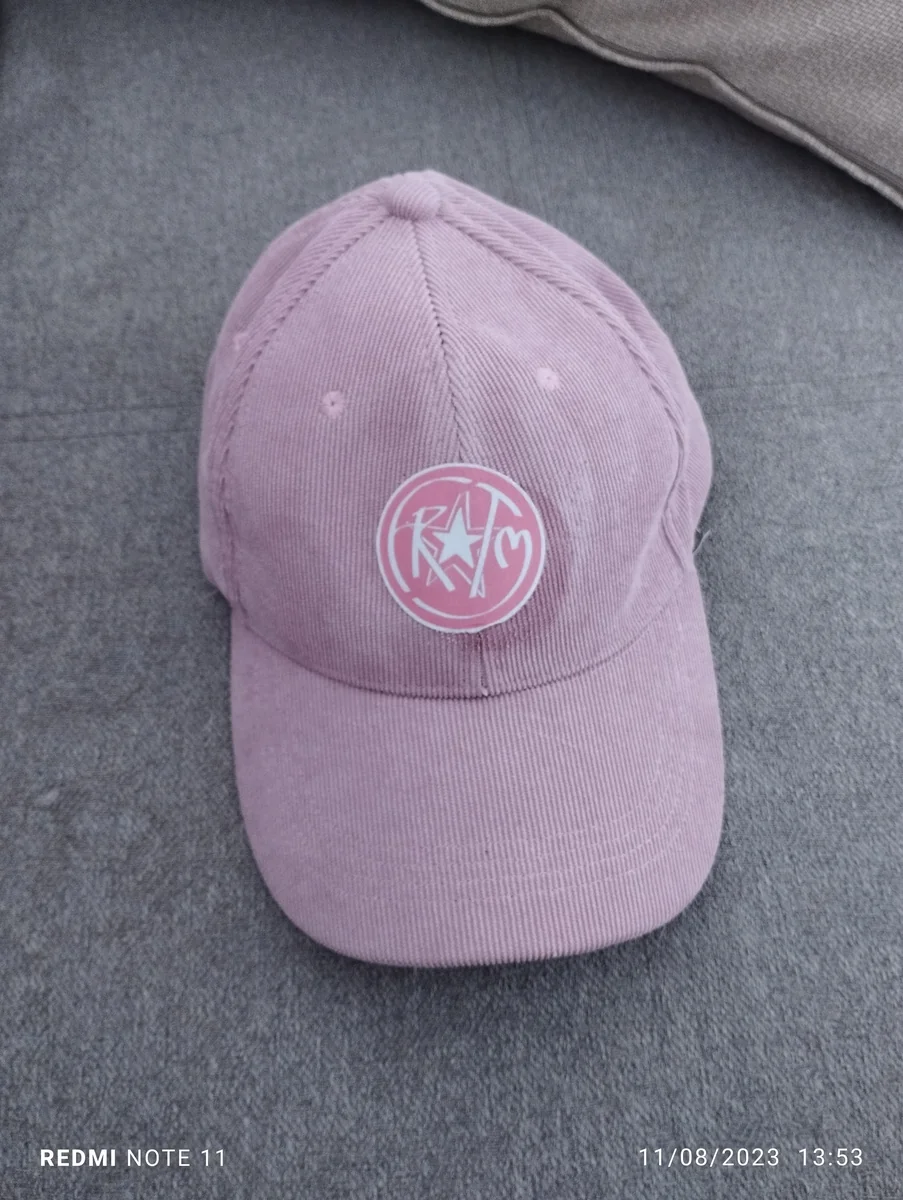
Real Production Case
Curved Crown Alignment on Ribbed Corduroy Dad Cap
This real production sample demonstrates our precision lockstitch sewing across a flexible low-profile crown. The round 2.25" emblem sits completely flat against the textured ribbed wales without fabric puckering or corner lifting.
Cap Placement & Dimension Limit Engineering Chart
Exceeding recommended placement limits causes patches to run into crown seams or flare at the edges ("winging"). Use the dimension limits below to calibrate your headwear artwork:
| Placement Location | Max Dimensions (Inches) | Max Dimensions (Metric) | Seam Clearance Rule | Optimal Patch Silhouette |
|---|---|---|---|---|
| Center Front (Standard 6-Panel) | 2.25" H × 4.25" W | 5.7 cm H × 10.8 cm W | Keep ≥ 0.5" (1.3 cm) above visor seam; center over middle seam | Curved rectangle, hexagon, oval, shield |
| Center Front (High-Crown 5-Panel) | 2.75" H × 4.50" W | 7.0 cm H × 11.4 cm W | Keep ≥ 0.5" (1.3 cm) above visor seam | Circle, square, oversized custom die-cut crest |
| Side Panel (Left / Right Temple) | 1.75" H × 2.50" W | 4.5 cm H × 6.3 cm W | Keep ≥ 0.75" (1.9 cm) above bottom sweatband | Small circle, national flag, subtle wordmark |
| Back Arch (Above Closure Strap) | 1.25" H × 3.50" W | 3.2 cm H × 8.9 cm W | Follows semi-circular strap cutout curvature | Arched rocker, narrow horizontal pill, woven tag |
| Beanie Folded Cuff | 2.00" H × 2.75" W | 5.0 cm H × 7.0 cm W | Center aligned on 2.5" to 3.0" folded brim | Square, horizontal rectangle, pinch clip label |
Calculate exact design area and pricing factors using our interactive custom patch size calculator.
Attachment Mechanics: Hook and Loop vs. Sew-On vs. Heat Press on Caps
Attaching a patch to a curved three-dimensional cap surface requires different mechanical considerations than applying a patch to a flat garment:
| Attachment Method | Application Speed | Long-Term Wash Durability | Curved Crown Performance | Recommended Application |
|---|---|---|---|---|
| Hook and Loop (Velcro) | Instant (press into loop field) | 100+ wash cycles (detach cap before washing) | Excellent — flexible hook backing conforms to curved panel | Tactical caps, uniform rotation, collectible drops |
| Machine Sew-On (Post / Cylinder Bed) | 1–2 minutes per cap (requires specialty headwear arm) | Permanent — will not detach under industrial laundering | Superior — lockstitch secures patch flush to buckram | Retail apparel brands, high-end lifestyle headwear, workwear |
| Heat Press / Iron-On (Heat Seal) | 15–20 seconds per cap | Moderate — prone to edge lifting after 15–25 wash cycles | High risk on flat presses; requires specialized curved hat platen | Promotional giveaways, short-run flat cotton caps |
Why Flat Heat Pressing Frequently Fails on Structured Caps: Attempting to heat-press patches onto finished 6-panel caps using a standard flat heat press is the leading cause of headwear decorating failure. Flat heating platens crush the curved buckram crown, causing permanent creasing. Furthermore, the raised vertical center seam acts as a pressure fulcrum, creating pressure voids on either side where the hot-melt adhesive fails to receive adequate pressure (4–5 bar). Over time or after washing, patch corners lift. Commercial decorators must use a specialized curved cap heat press with matched top and bottom curved platens, or choose machine sew-on or Hook and Loop for zero defect rates. Read our comprehensive patch backing guide for full adhesive specifications.
Curvature Engineering: Preventing "Winging" on Rigid Crowns
A standard 6-panel baseball cap features an arc radius of approximately 4.5" to 5.5" (11.5 cm to 14.0 cm) across the forehead. When a completely rigid, flat patch (particularly thick 3mm PVC or heavy felt embroidery) is stitched onto this surface, mechanical tension concentrates at the top and bottom corners, causing them to flare outward away from the crown fabric — an aesthetic defect known as "winging."
In our Dongguan manufacturing facility, PatchKey Works prevents crown flaring through three engineering safeguards:
- Pre-Curved Bottom Contour: For patches wider than 3.0" (7.5 cm), we slightly contour the bottom border with a subtle concave curve that naturally matches the cap visor seam line.
- Soft-Durometer PVC Casting: We cast headwear PVC badges using a specialized flexible 35–45 Shore A durometer compound, allowing the badge to flex smoothly along the crown radius without rigid resistance.
- Flexible Twill Substrate & Merrow Tensioning: We calibrate thread tension and twill backing weight so the finished embroidered patch bends easily around the cylinder sewing arm.
Direct Factory Sourcing: MOQ, Lead Times & Production SOP
Established in 2003 in Hengli Town, Dongguan, PatchKey Works operates an 8,100 m² manufacturing plant equipped with 150 Tajima and Barudan computerized multi-head embroidery machines, 20 high-density woven looms, and 15 automated micro-injection PVC dispensing lines under certified ISO 9001:2015 quality management and SMETA / BSCI audits:
Sampling Window
3–7 days (Rush 1–3 days)
Digital stitch proof provided after artwork reviewBulk Production
7–15 days (Rush 3–7 days)
Schedule confirmed on artwork approvalMinimum Order
From 100 pcs / design
Supports multi-colorway cap collectionsFactory Capacity
150 Embroidery / 20 Loom / 15 PVC
8,100 sqm plant in Hengli, DongguanFor volume pricing tiers and cost drivers, consult our guide on custom patch cost factors, or review our MOQ and lead time schedule.
Frequently Asked Questions
What is the standard patch size for a 6-panel baseball cap or trucker hat?
For a standard 6-panel structured cap, the ideal front patch size is 2.0 to 2.25 inches high by 3.5 to 4.25 inches wide (approximately 5.0 to 5.7 cm high by 9.0 to 10.8 cm wide). This leaves at least 0.5 inches (1.3 cm) clearance above the visor seam and stays within the natural curved front crown area.
Why do flat iron-on patches fail on curved hat crowns?
Standard flat heat presses cannot apply uniform pressure (4-5 bar) across a 3D curved crown. The raised vertical center seam of 6-panel caps creates pressure bridges, leaving adhesive voids on either side that peel after wearing or washing. Industrial headwear decorators use curved hat heat presses or choose sew-on or Hook and Loop attachment for permanent durability.
Hook and Loop vs sew-on: which backing is better for custom cap patches?
Choose Hook and Loop for tactical hats, uniform rotation programs, or collectible cap releases where patches are swappable or removed before washing. Choose permanent machine sew-on with a merrowed or laser-cut edge for retail apparel brands and commercial workwear where the badge must stay permanently attached.
How do 5-panel and 6-panel caps differ for patch design and application?
6-panel caps have a vertical center seam splitting the front crown, requiring a 3mm merrowed border or heavy twill backing to bridge the seam without puckering. 5-panel caps feature a seamless continuous front panel, accommodating larger patches up to 2.75 inches high and ultra-fine woven lettering down to 2mm with zero seam distortion.
What is the minimum order quantity and factory lead time for custom hat patches?
PatchKey Works provides direct factory manufacturing from Hengli Town, Dongguan with an MOQ starting from 100 pieces per design. Digital stitch simulation proofs are delivered after artwork review, physical samples in 3-7 days, and bulk production in 7-15 days.
⚡ Free Cap Curvature & Sizing Review
Launching a Headwear Collection or Custom Cap Program?
Send us your cap model (e.g. Yupoong 6606, Richardson 112, Flexfit), vector logo and target placement. Our factory engineering team calculates crown curvature, stitch density and backing recommendations with a free digital mockup after artwork review.
Direct Factory Pricing
Plan Your Custom Hat Patch Production
Direct manufacturer support from Hengli Town, Dongguan. Send your artwork, cap silhouette and target quantity for an accurate B2B factory quote.